
Introduction
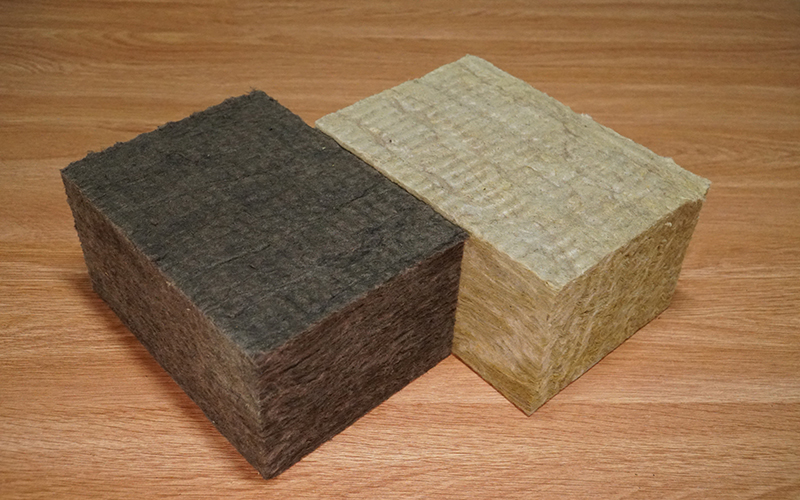
As the 2026 International Building Code (IBC) updates take effect across the United States, building energy efficiency and extreme fire protection have become the focal points for contractors and developers. Rock Wool Board, derived from natural volcanic rock, has transitioned from a specialized material to a primary requirement for modern construction. Its inorganic fireproof properties and long-term R-value stability make it the superior alternative to organic foam insulations. For B2B procurement managers, understanding these technical nuances is essential for both regulatory compliance and long-term cost reduction.
1. Physical Properties and Core Technical Advantages
1.1 Sustained Thermal Resistance
Rock wool board maintains a stable thermal conductivity coefficient between $0.034$ and $0.040 \text{ W/(m·K)}$. Unlike expanded polystyrene (EPS) or extruded polystyrene (XPS), rock wool does not experience “thermal drift”—the gradual loss of insulating power over time. This ensures the R-value remains constant throughout the 50-year lifecycle of a building, a critical factor for projects seeking LEED Zero Carbon certification.
1.2 Grade A1 Non-combustibility: The Ultimate Safety Barrier
With a melting point exceeding $1000^\circ\text{C}$ ($1832^\circ\text{F}$), rock wool is inherently non-combustible. In the event of a fire, it prevents flame spread and does not emit toxic smoke or flaming droplets. For high-rise commercial buildings and mission-critical facilities like Data Centers, utilizing ASTM E84 compliant rock wool is a primary strategy for reducing insurance premiums.
2. 2026 US Market Standards and Compliance
Product entry into the US market requires strict adherence to specific testing protocols. Procurement teams must verify the following three core standards:
2.1 ASTM C612 Compliance
This is the definitive standard for mineral fiber block and board insulation. Depending on density and operating temperatures, rock wool is categorized into several types:
-
Type IA/IB: Optimized for general building envelopes and interior partitions.
-
Type IV: Engineered for high-temperature industrial boilers and power generation equipment.
2.2 Fire Performance: ASTM E84 and UL 723
In the US, fire safety is measured by the Flame Spread Index (FSI) and Smoke Developed Index (SDI). Premium rock wool boards must achieve a “double zero” rating (FSI=0, SDI=0), meeting the requirements for Class A interior finishes.
3. High-Performance Application Scenarios
3.1 Commercial Rainscreen Systems
In contemporary architectural designs in cities like New York or Chicago, rock wool is the standard for rainscreen cavity insulation. Its hydrophobic (water-repellent) properties ensure that any moisture entering the cavity drains away, allowing the insulation to dry quickly and preventing structural mold growth.
3.2 Flat Roofing and Metal Deck Insulation
High-density boards (exceeding $140\text{kg/m}^3$) provide the compressive strength necessary to support foot traffic during maintenance. Additionally, it serves as an excellent sound attenuator, dampening the noise impact of heavy rain or hail on metal roofing.
3.3 Industrial and Marine Insulation
In chemical processing and maritime sectors, the chemical neutrality of rock wool (low chloride content) is vital. It prevents Stress Corrosion Cracking (SCC) on stainless steel piping and equipment surfaces.
4. Rock Wool vs. Glass Wool: Technical Comparison
To assist in the decision-making process, the following table highlights the performance gaps:
| Property | Rock Wool Board | Glass Wool |
| Max Service Temperature | >1000∘C | ≈250−400∘C |
| Density Range | 60−200 kg/m3 | 10−48 kg/m3 |
| Hydrophobicity | Excellent (with additives) | Generally lower |
| Primary Use Cases | Firewalls, High-load Roofs, Industrial | Light-gauge steel framing, Attics |
5. 2026 Procurement Strategies and Global Supply Trends
5.1 Price Trend Analysis
Due to fluctuations in raw material costs and global logistics, rock wool prices in 2026 are projected to remain firm. Procurement managers are advised to secure orders 12-16 weeks in advance to mitigate potential supply chain bottlenecks.
5.2 Quality Assurance Checklist for Overseas Sourcing
When evaluating manufacturers, prioritize the following criteria:
-
Raw Material Purity: Ensure the basalt content is high; excessive blast furnace slag can reduce fire resistance.
-
Binder Chemistry: Request formaldehyde-free options to comply with EPA and Greenguard standards.
-
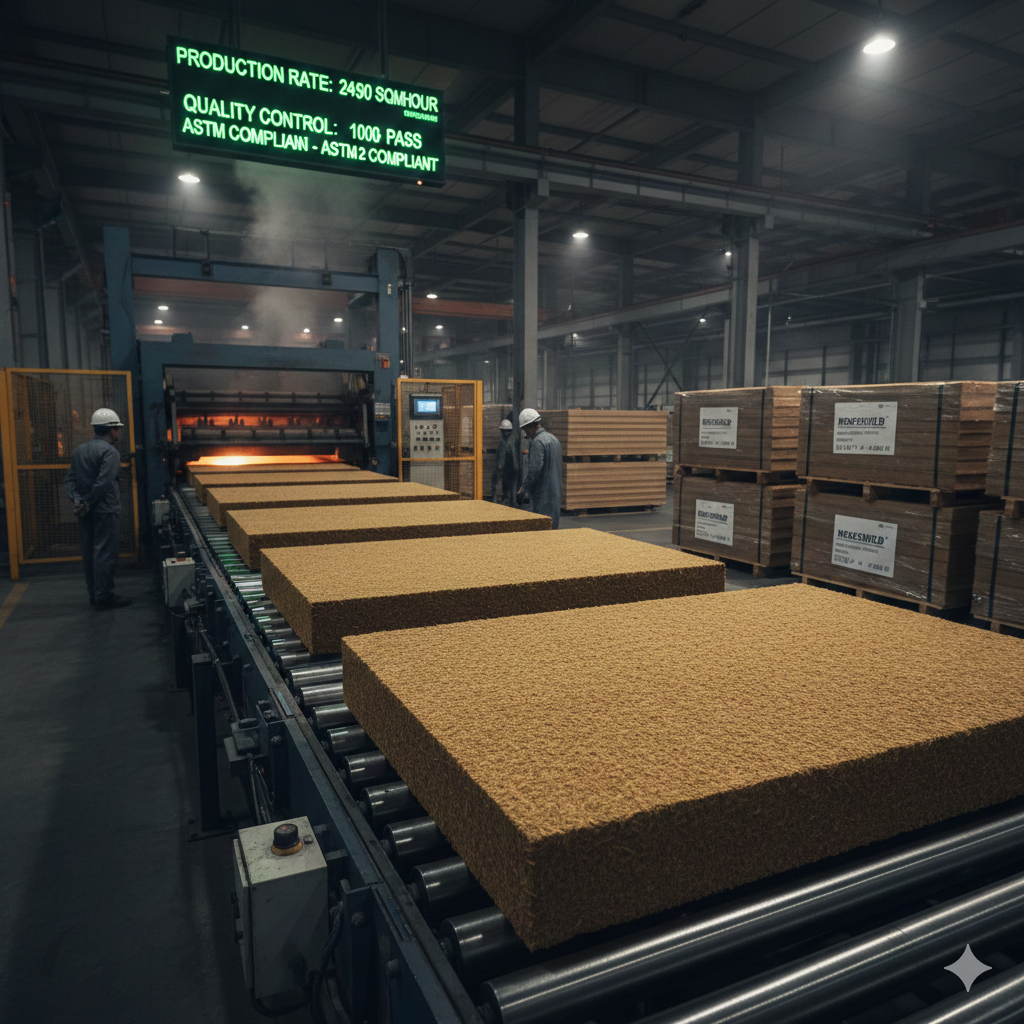
Reinforced Packaging: Confirm the use of edge protectors and heavy-duty shrink-wrapping to prevent damage during transoceanic transit.
6. Expert Perspective: The Sustainability Factor
“Over the next decade, building materials will be evaluated by their ‘Carbon Payback Period.’ Rock wool excels here; the energy saved by the insulation during its service life is over 100 times the energy consumed during its manufacture.” — Lead Engineer: [Jackie]
7. Frequently Asked Questions (FAQ)
Q: Is rock wool insulation safe for indoor air quality?
A: Yes. According to the International Agency for Research on Cancer (IARC), rock wool is classified in Group 3 (Not classifiable as to carcinogenicity to humans). Modern products are bio-soluble and meet stringent VOC emission standards.
Q: Can dimensions be customized to US imperial standards?
A: We provide full customization, including the standard $24″ \times 48″$ dimensions and thicknesses ranging from $1″$ to $8″$, ensuring seamless integration with US framing systems.
Conclusion
As the global construction industry moves toward Net-Zero Energy Buildings (NZEB), rock wool has evolved from an optional upgrade to a fundamental requirement. Our facility is dedicated to providing US-based clients with high-standard insulation solutions that bridge the gap between regulatory compliance and project profitability.
Post time: Jan-27-2026